What Happens After "Contact Sales"? Streamlining Your B2B Sales Pipeline
Every B2B company with an enterprise offering has that familiar "Contact Sales" button. It’s the entry point to potential deals and the start of what could become a long-term client relationship. But what really happens after someone clicks it?
For many B2B teams, the answer involves a whirlwind of manual tasks and tool-switching. A lead gets (hopefully) logged into your CRM. Then come the copy-pasting marathons: moving data into proposal documents, exchanging emails for edits, using yet another tool for contracts, and finally re-entering everything into an invoicing system. The outcome? A fragmented process that drains time, invites errors, and leaves your team chasing payments in spreadsheets.
But it doesn’t have to be this way. Imagine managing the entire deal lifecycle — from the moment a prospect clicks "Contact Sales" to the final invoice — in one seamless system. That’s the promise of a zero-handoff platform like IntoPact. Let’s explore how it can transform your sales process and give your team back the time they need to focus on what truly matters: closing deals.
The Challenges of Traditional B2B Sales Pipelines
For many B2B teams, the traditional sales pipeline feels like a patchwork of disconnected tools and manual processes. Here’s where it often breaks down:
- Data Silos: Leads are entered into one tool, transferred to another for proposals, and re-entered again for contracts and invoicing. Each handoff increases the chance of errors and slows progress.
- Time-Intensive Admin: Sales reps spend hours updating spreadsheets, chasing approvals, and manually creating documents — time that could be spent building relationships and closing deals.
- Friction for Buyers: Disjointed workflows lead to delays, miscommunication, and unnecessary back-and-forth, creating a frustrating experience for buyers.
- Missed Revenue Opportunities: Bottlenecks and invoicing errors can stall deals or delay payments, directly impacting your bottom line.
The good news? These pain points aren’t inevitable. A streamlined, all-in-one approach can eliminate inefficiencies and help your team operate at peak performance.
What Is a Zero-Handoff Sales Pipeline?
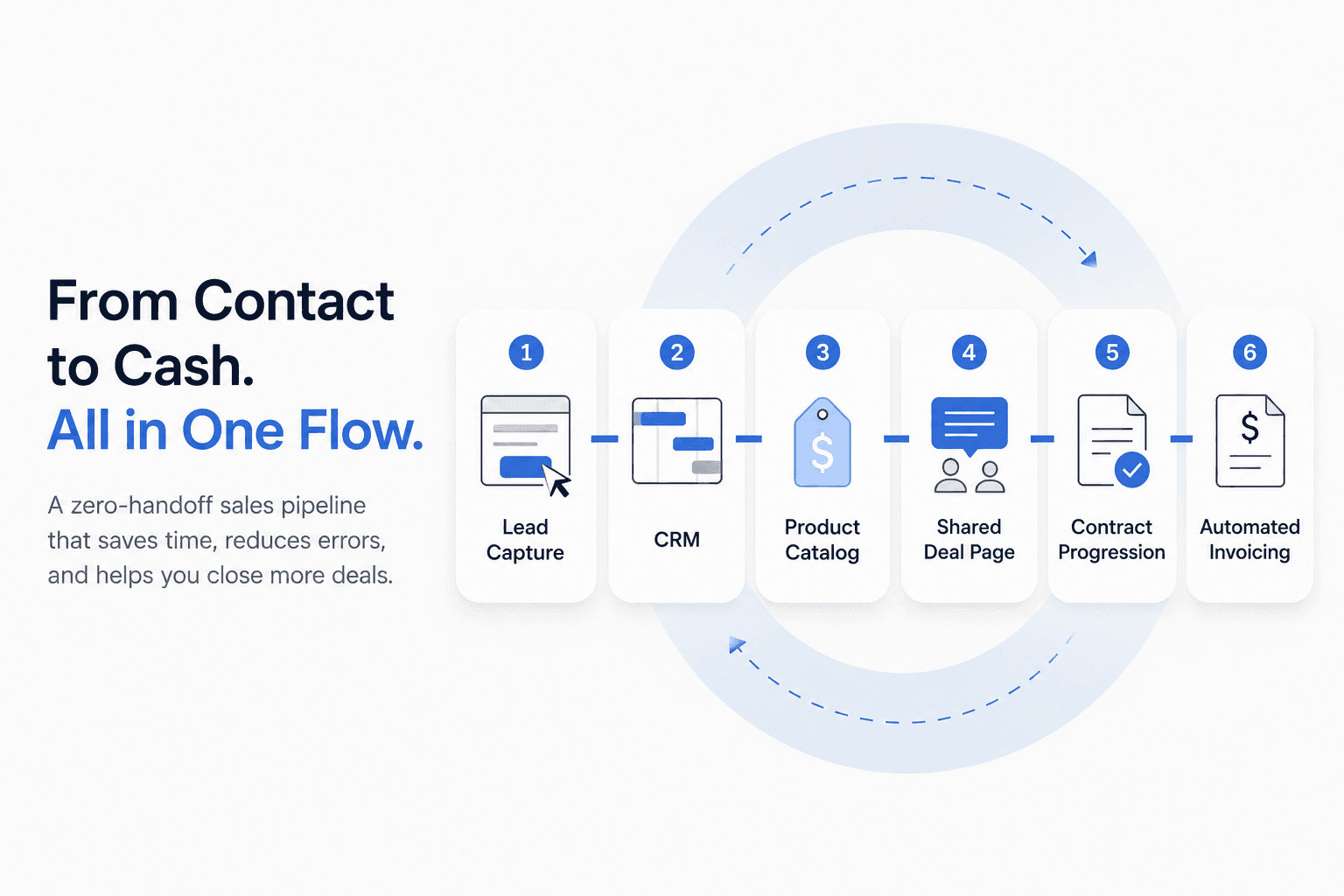
A zero-handoff sales pipeline eliminates the need to juggle tools or manually re-enter information at different stages of the deal. Instead, data flows seamlessly from lead capture to payment. Here’s how it works:
- Lead Capture: A buyer clicks "Contact Sales" and fills out a form. Their information flows directly into your CRM, eliminating manual entry.
- Deal Creation: Products, pricing, and terms are defined in a central product catalog. No more copying details into separate proposal tools.
- Collaboration: Share a live deal page with your buyer, where they can review options, ask questions, and select pricing and payment terms — all without needing an account.
- Contract & Payment: Once the buyer accepts, the system automatically generates contracts, invoicing schedules, and payment details. No mismatches, no delays.
This approach saves time, reduces errors, and ensures consistency across the entire sales journey. Let’s break down the core components of this streamlined workflow.
The 6 Key Components of a Seamless B2B Workflow
1. Lead Capture: Turning Interest into Action
Efficient lead capture is the foundation of any sales pipeline. Platforms like IntoPact let you create tailored landing pages, customizable forms, or integrate with APIs, ensuring every lead flows directly into your CRM without manual input.
Pro Tip: Use dynamic forms to qualify leads upfront. Ask about company size, budget, or timeline to prioritize high-value prospects.
2. Lightweight CRM: Managing Your Pipeline with Ease
A bloated CRM can slow you down. What you need is a lightweight solution that keeps your pipeline organized without unnecessary complexity.
Key features to look for:
- Clear visibility into where each deal stands.
- Task assignments and reminders for timely follow-ups.
- Seamless integration with the rest of your workflow to avoid duplication or delays.
With IntoPact, your CRM is directly connected to every other stage of the sales process, ensuring deals move forward effortlessly.
3. Centralized Product Catalog: Simplifying Pricing & Terms
Managing product details and pricing across multiple tools is a common headache for B2B teams. A centralized product catalog solves this by enabling you to define:
- Products or services offered.
- Pricing tiers, discounts, and payment terms.
- Subscription and renewal options.
When everything is pre-configured in one place, creating accurate proposals becomes quick and stress-free, while eliminating errors that could derail a deal.
4. Shared Deal Pages: Collaborating Without Barriers
Traditional proposals often involve static PDFs, long email threads, and version control nightmares. Shared deal pages change the game by offering a single, interactive space for collaboration.
Why It Works:
- Buyers can ask questions or suggest changes directly on the page.
- No logins required for buyers, minimizing friction.
- Engagement metrics let you see how buyers interact with the page, so you can follow up strategically.
This transparency accelerates decision-making and creates a smoother buyer experience.
5. Seamless Contract Progression: From Proposal to Signed Deal
Moving from proposal to contract shouldn’t feel like starting from scratch. In a zero-handoff pipeline, contracts are automatically generated based on agreed terms, ensuring accuracy and consistency.
You can also manage renewals, amendments, and cancellations directly within the same platform, reducing admin work and maintaining continuity.
6. Automated Invoicing: Closing the Loop with Confidence
Getting paid is often the most tedious part of the sales process. Automated invoicing simplifies this by:
- Generating invoices based on the buyer’s selected payment terms.
- Sending invoices automatically when due.
- Offering integrated payment options to speed up collection.
This ensures faster payments while freeing your team from manual tasks like chasing invoices or reconciling accounts.
Why B2B Teams Need an All-in-One Platform
B2B teams face unique challenges: lean resources, founder-led sales, and the pressure to scale without adding complexity. An all-in-one platform like IntoPact addresses these challenges by:
- Reducing Tool Overload: Eliminate the need for multiple tools for CRM, proposals, contracts, and invoicing.
- Saving Time: Automations handle repetitive tasks, letting your team focus on building relationships.
- Ensuring Accuracy: A single source of truth minimizes errors and keeps everything aligned.
- Enhancing Buyer Experience: A seamless, transparent process makes it easier for buyers to commit.
When your team spends less time on admin and more time on selling, you’re not just improving efficiency — you’re driving revenue growth.
Conclusion: Streamline to Scale
B2B sales don’t have to be a maze of disconnected tools and manual processes. With a zero-handoff pipeline, you can achieve efficiency, accuracy, and scalability — all without the complexity of traditional enterprise systems. From capturing leads to automating invoicing, every step of the sales journey can be streamlined into one cohesive workflow.
If your team is ready to leave behind spreadsheets and tool sprawl without investing in an expensive tech stack, an all-in-one platform like IntoPact is the solution. It’s time to simplify your pipeline, delight your buyers, and close deals with confidence.
Ready to transform your sales process? Let’s get started.
Ready to close deals faster?
From “Contact Sales” to cash — one platform for structured B2B deals. No handoffs, no stitched tools.
Book a demo