Why CRMs Alone Are Not Enough to Win Deals
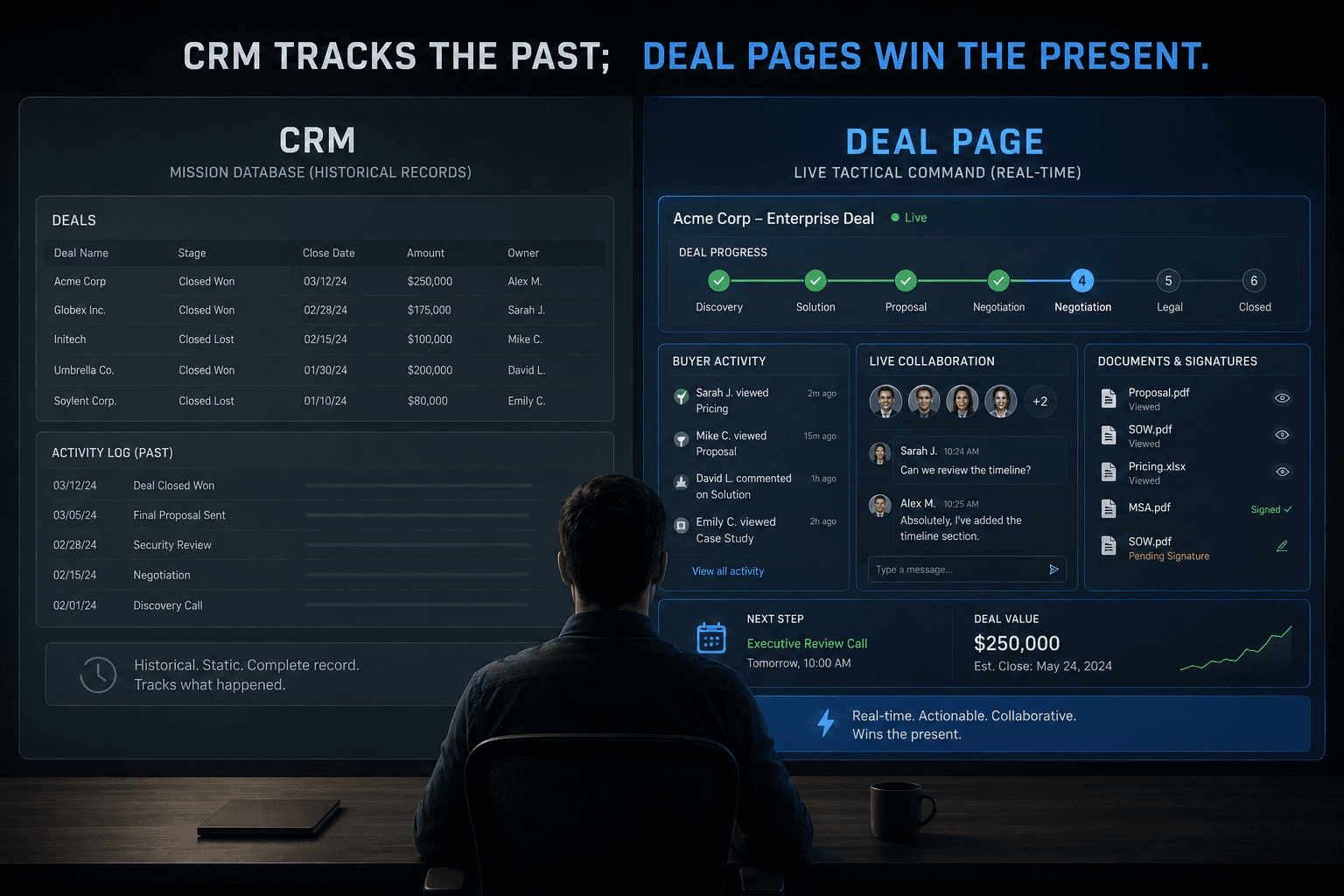
When it comes to managing sales, your CRM is often hailed as the single source of truth. It’s where all your data lives—your pipeline, contacts, activities, and forecasts. But here’s the problem: CRMs are systems of record. They provide a historical snapshot of what’s already happened, not a real-time view of what’s unfolding in your deals today.
Winning deals isn’t about reviewing lagging indicators. It’s about managing the dynamic, fast-moving battlefield of a sales cycle. And that’s where deal pages come in. By replacing static PDFs, fragmented landing page tools, and clunky e-signature platforms, deal pages provide a single, shareable URL that evolves with the buyer journey. They bridge the gap between what your CRM tracks and what actually drives deals forward.
In this post, we’ll explore why CRMs aren’t enough to win deals on their own and how dynamic deal pages can help you track, collaborate, and close more effectively.
CRMs: Great for Data, Not for Deals
Your CRM is an essential tool for organizing information. It’s where your sales team logs customer details, tracks deals, and forecasts revenue. But here’s the catch: CRMs are static by nature. They reflect what has already happened—emails sent, calls logged, meetings scheduled—not what’s happening in real time.
The Lagging Indicators Problem
CRMs are excellent at capturing lagging indicators, such as:
- Historical Data: When was the last email sent? How many calls did this prospect receive?
- Pipeline Stages: What stage is this deal in? When was it last updated?
- Forecasts: What’s the predicted close date, and how much revenue is expected?
But none of this tells you how engaged your buyer is right now, what content they’ve viewed, or whether they’re aligned with your value proposition. These insights are critical for driving deals forward—and they’re completely missing from your CRM.
The Collaboration Gap
CRMs are also siloed tools. They’re designed for internal use, meaning your buyers rarely, if ever, interact with them. This creates a disconnect between how your team manages deals internally and how buyers experience them externally. And in today’s buyer-driven sales environment, that gap can be the difference between a won deal and a lost one.
What Are Deal Pages?
Deal pages are dynamic, evolving URLs that consolidate the entire sales process into a single, interactive experience. Think of them as living documents that replace traditional PDFs, static proposals, and disjointed tools like landing pages or e-signatures.
Here’s how deal pages work:
- Centralized Content: All relevant deal information—proposals, pricing, timelines, and more—is housed in one place.
- Real-Time Updates: As the deal progresses, your deal page evolves. You can add new content, update terms, or address objections on the fly.
- Buyer Engagement Insights: Track exactly when and how buyers interact with your deal page, gaining valuable insights into their level of interest.
By focusing on what’s happening right now, deal pages provide the real-time visibility and collaboration tools CRMs lack.
Why Deal Pages Are the Missing Link in Your Sales Tech Stack
If your CRM is the brain of your sales operation, think of deal pages as the beating heart. They bring the static data from your CRM to life, enabling real-time collaboration and buyer engagement. Here’s why they’re the perfect complement to your CRM:
1. Real-Time Buyer Insights
With deal pages, you can track buyer activity in real time:
- See when buyers open your deal page and how long they spend on each section.
- Get notified when multiple stakeholders view the deal, signaling strong internal alignment.
- Identify which parts of your proposal resonate most—and where buyers drop off.
These insights allow you to tailor your follow-ups and address objections proactively.
2. A Single Source of Truth for Buyers and Sellers
Unlike CRMs, which are internal tools, deal pages are outward-facing. They provide a unified experience for both sides of the table:
- For Sellers: All deal-related materials are in one place, reducing time spent hunting for documents or updating multiple tools.
- For Buyers: A seamless, centralized experience that eliminates the headache of juggling multiple email threads, attachments, and links.
When buyers and sellers are on the same page—literally—deals move faster.
3. Streamlined Collaboration
Sales today is a team sport, involving multiple stakeholders on both sides. Deal pages enable seamless collaboration by:
- Allowing sellers to update terms or content instantly, ensuring buyers always have the latest information.
- Providing a single URL that can be shared across teams without losing context.
- Offering comment or chat functionality directly within the deal page, so questions and feedback don’t get lost in email threads.
4. Closing Without Friction
Traditional closing tools—like standalone e-signature platforms—add unnecessary friction to the deal process. Deal pages integrate e-signature functionality directly into the experience, so buyers can review, approve, and sign in one seamless flow.
How to Use Deal Pages to Win More Deals
Implementing deal pages is straightforward, but maximizing their impact requires a strategic approach. Here’s how to get started:
1. Consolidate Your Sales Materials
The first step is to centralize all your deal-related content. This includes:
- Proposals and pricing information
- Case studies or testimonials
- Timelines and next steps
- Contract and e-signature functionality
With everything in one place, buyers have a clear, streamlined experience.
2. Leverage Engagement Data
Use the insights from your deal pages to tailor your outreach. For example:
- If a buyer spends extra time on pricing, schedule a call to address potential concerns.
- If multiple stakeholders view the deal, focus your messaging on aligning their priorities.
- Use drop-off points to refine your content and eliminate friction.
3. Keep the Momentum Going
Sales cycles often stall due to lack of momentum. Deal pages help you maintain a steady cadence by:
- Providing real-time updates, ensuring buyers always have the latest information.
- Enabling quick collaboration, so questions and objections don’t become bottlenecks.
- Simplifying the closing process with integrated e-signatures.
The Future of Sales: CRMs + Deal Pages
Your CRM is a valuable tool, but it’s not enough to win deals in today’s competitive landscape. CRMs capture what’s already happened; deal pages capture what’s actually happening. Together, they provide a complete picture of the sales process, from historical data to real-time buyer engagement.
By integrating deal pages into your sales tech stack, you can:
- Gain real-time visibility into buyer behavior.
- Streamline collaboration between buyers and sellers.
- Close deals faster with less friction.
The battlefield of sales is dynamic, fast-paced, and unpredictable. To win, you need tools that move as quickly as your deals evolve. Deal pages are that missing link—transforming your sales process from reactive to proactive.
Conclusion: Evolve Your Sales Process with Deal Pages
The sales world is shifting. Buyers expect seamless, personalized experiences, and static tools like CRMs and PDFs can’t keep up. Deal pages offer a modern solution, empowering your team to manage deals in real time, collaborate effortlessly, and close without friction.
If your CRM is your system of record, think of deal pages as your system of engagement. Together, they create a powerful one-two punch that equips your team to win more deals—and win them faster.
It’s time to step off the sidelines and onto the battlefield. Are you ready?
Ready to close deals faster?
From “Contact Sales” to cash — one platform for structured B2B deals. No handoffs, no stitched tools.
Book a demo